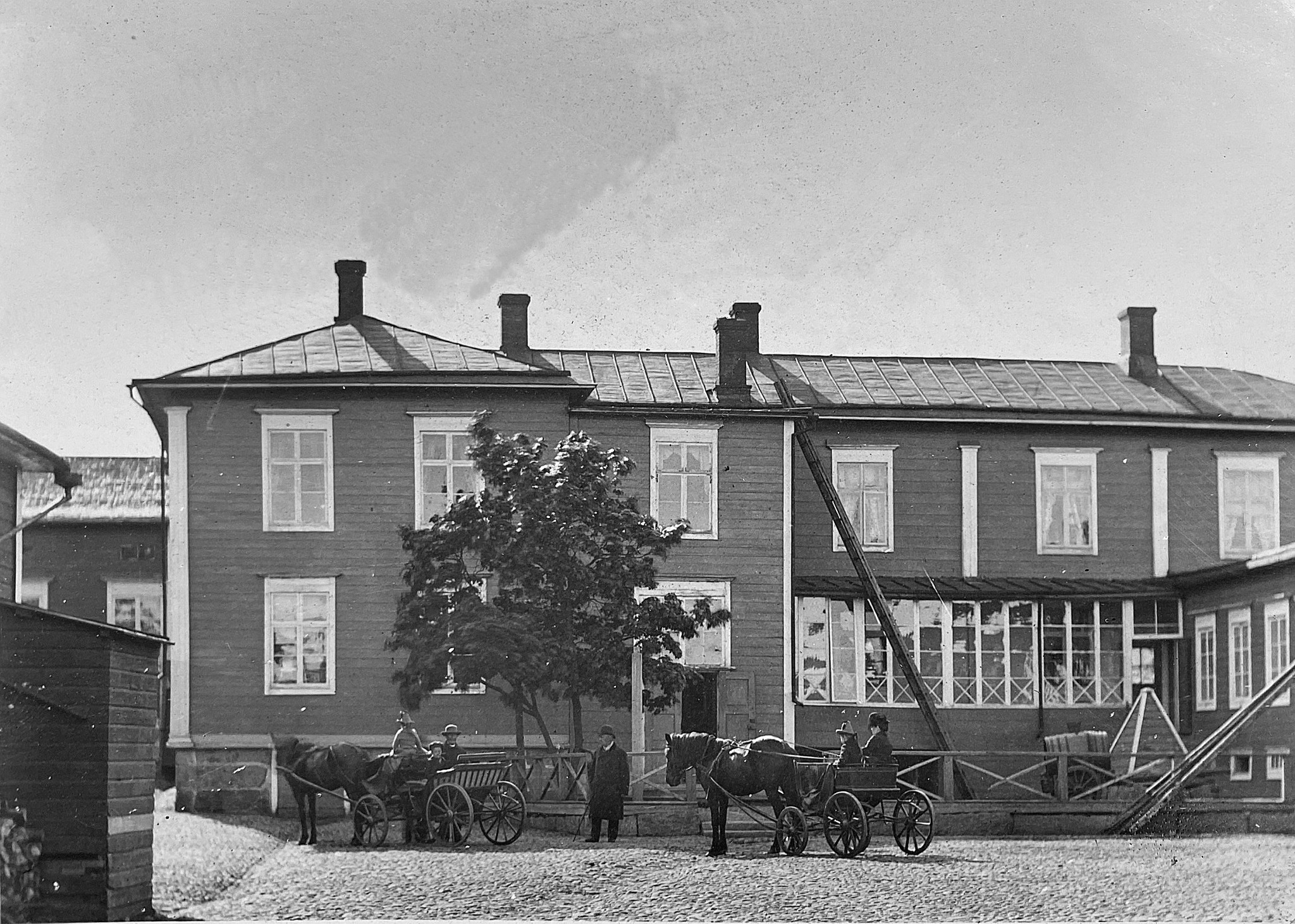
street: Strandgatan

Carl Emil Carlströms gård

Carl Emil Carlströms gård

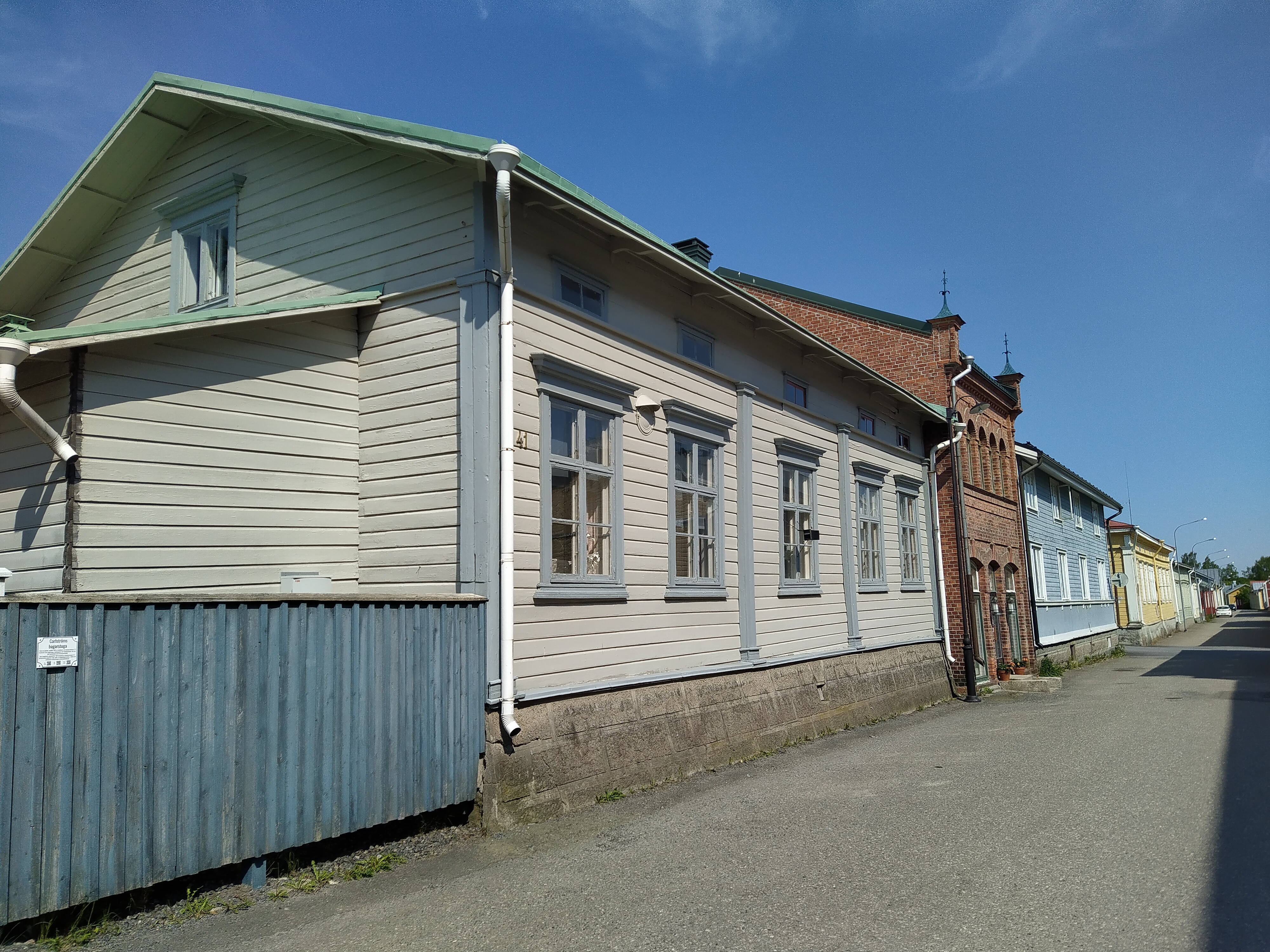
Husets första del byggdes år 1804,  brädfodrades 1824 och byggdes till första gången år 1833, då det ägdes av Gottfrid Starcke med hustru Maria Rebecca.

Efter att Carl Emil Carlströms (som även ägde bl.a. Carlso) gård på nuvarande kyrkotomten hade förstörts i den stora branden år 1859, köpte han detta hus. Under Carlströms tid renoverades huset och byggdes till.  

Huset revs 1965 av byggmästare Thure Nygren.

Före rivningen fanns i huset inhyst från norr: ”Naftalinboden” i folkmun, en butik med garn och tyger, som luktade naftalin (användes mot mal), Marta Nordlunds frisörsalong och Mjölkcentralen som sålde mjölk, smör, grädde mm. I övre våningen fanns bostäder

Byggnadshistoria

Byggnaderna år 1834 enligt brandförsäkringsbrevet och planteckningen längre ner var.

  1. En träbyggnad af furu timmer i godt stånd af nytt timmer uppförd år 1804 af 2 våningar brädfodrad år 1824 och sedermera med nytt grantimmer tillbyggd år 1833. Målad med dels olje och dels rödfärg. Bestående av 8 rum i nedre våningen

Planteckning af åbyggnadernes läge å undertecknads ägande gård No 129 i Christinestad, samt dertill gränsande hus. Brandförsäkringsbrevet från 1834

Ägare och invånare

Ägare enligt brandförsäkringsbreven

1834-1840
Gottfrid Starcke äger gården

1846-1856
Gården har övertagits av herr handelsmannen H.O Fontell

1861-1866
Handlanden Carl Emil Carlström

1891
Kommerseråde Carl Emil Carlströms arvingar

Brandförsäkringsbrev N:o 121 från år 1834 å gården 129 i tredje qvarteret af staden Christinestad
Brandförsäkringsbrev N:o 4473 från år 1861 å gården 3 i tredje qvarteret af staden Christinestad
Brandförsäkringsbrev N:o 29295 från år 1920 å gården 129 i tredje qvarteret af staden Christinestad
Brandförsäkringsbrev N:o 29295 från år 1910 å gården 129 i tredje qvarteret af staden Christinestad
Brandförsäkringsbrev N:o 23037 från år 1922 å gården 129 i tredje qvarteret af staden Christinestad
Piirusuts osasta taloa ja tonttia no 129 tässä kaupungissa Kristiina 14 p:nä elok. 1914
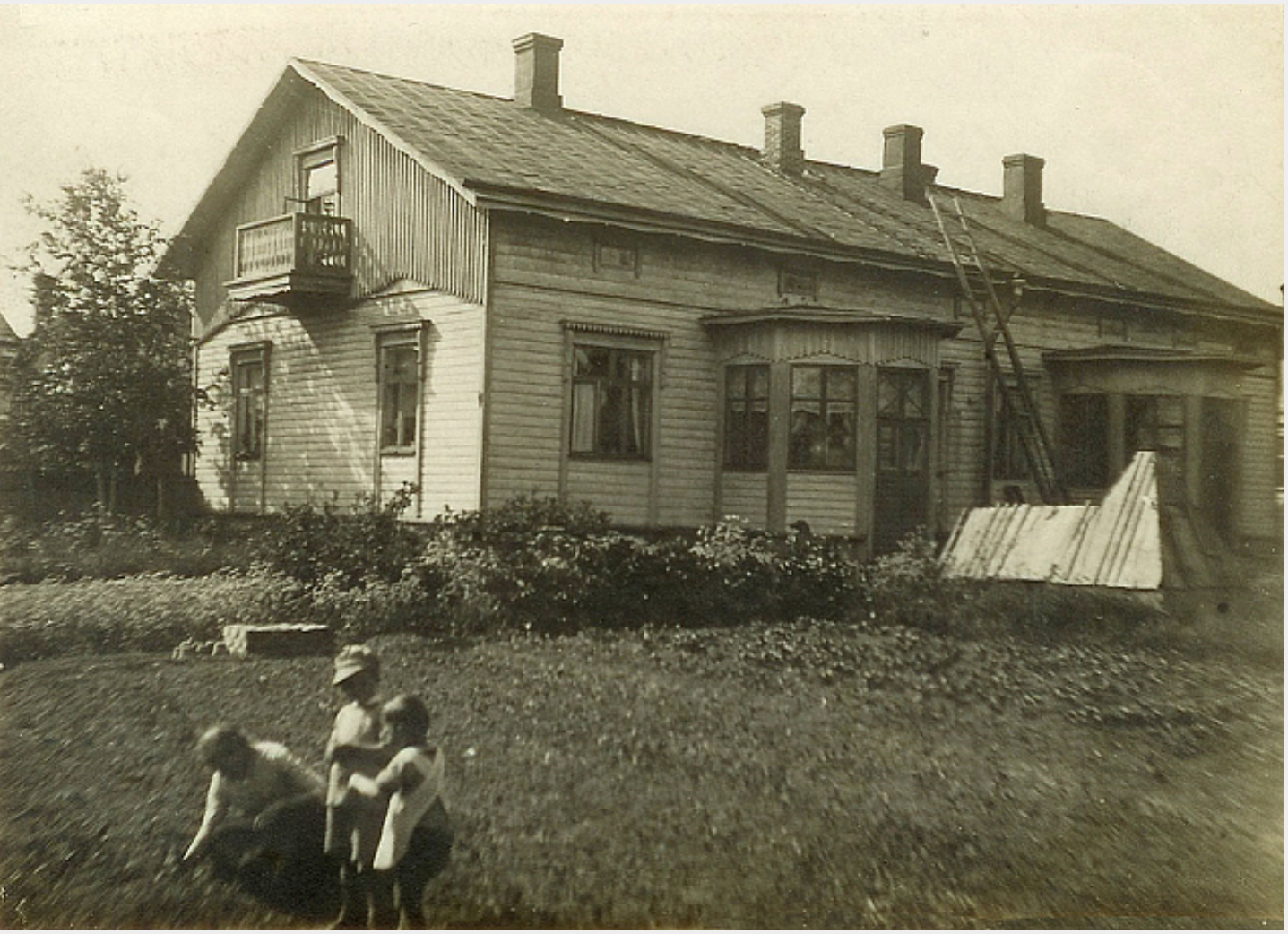
Torppa

Torppa

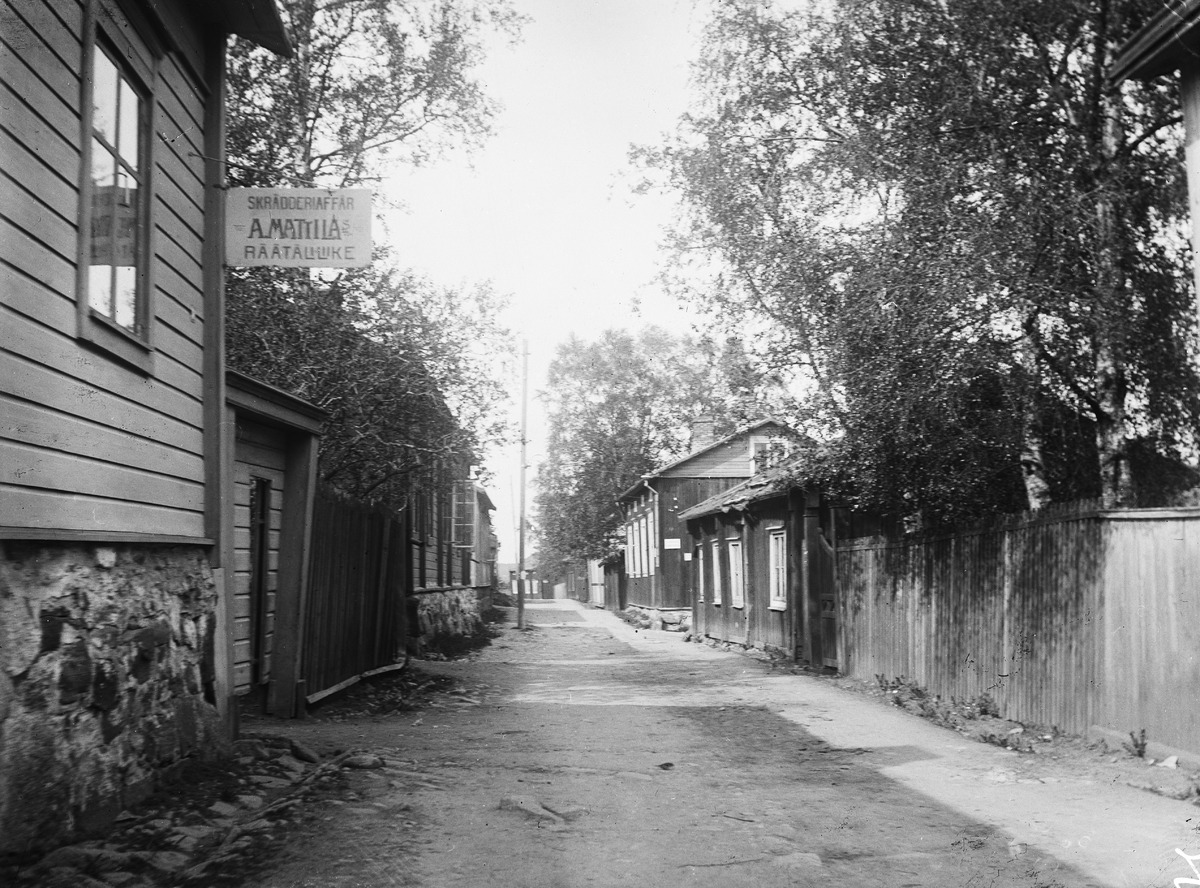
During the troubled times of 1914-1920, this house was owned by the “Socialist Association Torppa”. Before the Civil War until the capture of the city in January 1918, Torppa was the Red Guards’ meeting place and gathering place (source Lasse Backlund).

Building history

The house in the picture, on the right after the plank, was built in 1801 according to the fire insurance policy. It is said that the house would have been demolished around the 1920s and the current house would have been built on the same site. The house is now taller and has a higher stone base than in the photograph, while the window division is the same.

At the bottom of the page we have a building plan for the fireplace alteration, and extension, of the then existing building. In the picture below we have marked how the old house is extended to the east, and the stone base is raised (not uncommon for the stone base to be rebuilt on a house). The pink colors suggest changes. It is less clear whether the house is also raised upwards, but it seems so. The house being rebuilt is certainly the house from 1801.

According to this, it seems clear that the old house was not demolished, but rebuilt into the house that stands here today. Or at least we can safely say that this was planned with this building plan, which was also approved. It is still conceivable that the plans were changed and the house was demolished anyway.

Allmänna brandstods-bolaget i Finland antager härigenom, under N:o 3167, till försäkring emot Brandskada innenämnde byggnader, å gården No 213 i fjerde qvarteret af staden Christinestad. År 1851
Piirustus korjaus ja lisärakennusta varten tontille No 213 IVssä : kaup:osassa Kristiinassa 1921

Owners and residents

Read about ownders and residents on Lasse Backlund’s page

Text: Dag Björklund

Mayoress Forsman’s house

Mayoress Forsman’s house

The building adjacent to the street was built in 1818. It is an example of Finnish wooden architecture in the Neo-Classic Empire style, with broad horizonal panelling and pilasters.

The plot extends through the block from Strandgatan to Östra Långgatan, and this has been the case since the 18th century. From 1873 until the 2000s, there were two inhabited buildings on the plot, the main house on Strandgatan and a building along the northern side of the plot – see Carlström’s bakehouse.

In 1834 the house was owned by Johanna Christina Forsman, widow of the Mayor of the town of Kaskinen, Wilhelm Forsman. After her death in 1839, the ownership passed to her daughter Johanna Carolina.

From 1866 the property became part of the Carlström shipping and trading company, which dominated much of the business locally. It was bought by Carl Emil Carlström, who himself lived in a two-storey house on the other side of Strandgatan. The property was inherited in 1889 by his son Carl Alfred Carlström, who lived on Östra Långgatan above the plot. After Alfred’s death, the house was bought by fisherman Johan Carlberg in 1911 and then passed to his heirs.

The sea captain Emil Weckström was the owner of the property from 1918 to 1923. Until the First World War, he was the commander of s/s Hyllos, one of the largest Finnish steamships of the period,
owned by the local Navigator shipping company.

In 1923, the Ingves family took over, with the owners Emil Ingves, his widow Selma and finally Emil’s father Henrik until 1935. Emil died young, but reached fame by founding the first local White Guard
in Finland, in the village of Lappfjärd outside Kristinestad. This voluntary militia movement had a decisive role for the outcome of the Finnish civil war in 1918.

During the Ingves family ownership, the houses were rented out to several tenants, including Rosa Rosenqvist, who ran a restaurant and café in the main building and temporary accommodation in the
house in the courtyard. Rosenqvist bought the property in 1935 and continued her business here until 1946. Later owners include Bertel Rusk, a department manager at Kesko wholesale company, in
the 1960s.

Rosa Rosenqvist och telearbetare 1938, Esko Hellstens samlingar
Text: Staffan Martikainen. The Swedish version is the main version with more information


Gamla tullkammaren

Gamla tullkammaren

Brandförsäkringsbrev N:o 1030 från år 1834 å gården 169 i fjerde qvarteret af staden Christinestad
Brandförsäkringsbrev N:o 7451 från år 1871 å gården 169 i fjerde qvarteret af staden Christinestad
Brandförsäkringsbrev N:o 12487 från år 1883 å gården 169 i fjerde qvarteret af staden Christinestad
Brandförsäkringsbrev N:o 19264 från år 1894 å gården 169 i fjerde qvarteret af staden Christinestad
Brandförsäkringsbrev N:o 34748 från år 1916 å gården 169 i fjerde qvarteret af staden Christinestad
Brandförsäkringsbrev N:o 36646 från år 1918 å gården 169 i fjerde qvarteret af staden Christinestad

Södra halvan av huset byggdes 1819 och inhyste stadens tullkammare. Huset hade vackra målningar på stockväggen som finns bevarade under nyare ytmaterial.
Norra delen tillkom 1842. År 1883 uppfördes på gården en byggnad för rening och destillering av brännvin som nu är borta.

Byggnadshistoria

Huvudbyggnadens historia kan delas in i två skeden enligt brandförsäkringsbreven: i det första skedet bestod huset av endast södra hälften där stadens tullkammare var inhyst. Detta hus uppfördes 1819, brädfodrades 1824 och var vid ingången av år 1834 målat med brun oljefärg, storleken uppgick till 18 x 9,9 x 9 meter under tak av näver, rummen var 6 till antalet omfattande 1 sal, 3 kamrar och en farstu med tillsammans 4 kakelugnar med “bildhuggerier” och oljemålning samt 1 köksspis med bakugn. På vinden fanns en skild kammare med kakelugn av tegel.

2 rum var 1834 försedda med franska vattenfärgade tapeter och 2 bemålade med vattenfärg direkt på den klinade stockväggen (det ena måste ha varit den sal med pilastrar i grått och gult målade direkt på väggen , vilket syntes vid renoveringen i slutet av 80-talet, se bilden.)

Norra delen av huset och de ursprungliga farstukvistarna uppfördes 1842, då tillkom en huskropp med längden 14,7 meter och samtidigt försågs hela huset med tak av profilerade bräder. Den nya delen av huset omfattade 5 rum: 3 kammare, 1 farstu och 1 bagarstuga med tillsammans 4 kakelugnar och en bakugn med spis. Tre rum försedda med franska tapeter.

I försäkringsbrevet daterat 5.9.1883 uppger Charles Uno Nordlund (som senare började med telefonbolag) att antalet rum uppgick till 13 st med tillsammans 9 kakelugnar, 2 köksspisar och 1 bakugn, huvudbyggnaden är försedd med pärttak och målad med ljus oljefärg. Uthusbyggnaden vid tomtens norra sida uppges ha varit uppförd 1828, till en del bärdfodrad och målad under pärttak , storleken uppgående till 41,40 x 7 x 6 meter och omfattande 1 magasin, 1 vagnslider, 1 stall, avträde med dyngstad, fähus, förstuga, foderlada, och vedlider.

I tomtens östra ända uppges dessutom finnas en 1883 uppförd destillationsbyggnad (se ritning) under tak av asfaltfilt med storleken 12 x 6 x 6 meter och omfattande 3 rum, varav 1 boningsrum med kakelugn, 1 kallreningsrum med vattenledning och 1 destillationsrum. Huset uppges ha rappade väggar.

Ritning å en byggand af stock under asfalttak att uppföras å tomten No 169 i 4:de qvarteret af Kristinestad tillhörig Handlanden C U Nordlund och förafsedd till rum för rening och destillering af brännvin

Inkörsporten var målad med oljefärg och trädgården försedd med 9 stora, lummiga, ädla lövträd. Huvudbyggnaden försågs med nyrenässansinredning i slutet av 1800-talet liksom rundbågade verandafönster vid samma tid.

Text: Förslag till förbättring av stadsbilden: Strandgatan mellan Salutorget och Kolargränden, Wenman Niklas, Talotuuma, 1996

Tapetbord och s.k. Iris-tapet från någon av väggarna. Fotografi av fragment, Liisukka Oksa
Pilastrar i grått och gult målade direkt på väggen. Fotograferat av målarmästare Rune Wicklen i samband med pappspänning av väggen under renovering på 1980-talet.
Ritning till inre- och yttre förändringar av boningshuset å tomten No 27 i 1:sta stadsdelens 50:de kvarter av Kristinestad.
Ritning till boningshus, uthusbyggnad och tvättstuga att uppföras å tomten 169 i 4:de kvareteret av Kristinestads gamla plan.
Ritning till nybyggnad att uppföras å tomten och gården No 27 i 1:sta stadsdelens 50:de kvarter av Kristinestads nya stadsplan.

Sidan skapad av Dag Björklund

Ägare och invånare

Ägare enligt brandförsäkringsbreven

1834, 1840 och -46 Staden Kristinestads tullkammare

1871 Norra hälften tillhörig Kristinestads enskilda Handelskassa , södra hälften tillhörig Staden

1883 Handlanden Charles Uno Nordlund

1916 Änkan Augusta Nordlund

The old pharmacy

The old pharmacy

The city’s pharmacy operated in this building for almost a hundred years (1836-1930). The house almost burned down three times when serious fires occurred in the pharmacy’s laboratory. The house has been in the current owner’s family for 128 years so far.

Conrad Berggårdh’s book Kristinestads apotek och dess innehavare under 150 år (1786-1936), published in 1936, describes the pharmacy’s operations:

Carl Gustavf Thodén bought the house N:o 170 in the IV block at Strandgatan and turned it into a pharmacy. The pharmacy was thus located on the street that was an entrance to the town centre from the north. The pharmacy probably had two large and one smaller room on the north side of the building. Less than a year after Thodén received the privilege of the pharmacy in Kristinestad, he passed away at the age of 27.

The pharmacy was taken over in 1837 by Fredrik Wilhelm Jurvelius, a relative of Thodén, and he bought the house in 1839 from the widow Thodén. In 1846 the building almost burned down. The fire had started in the laboratory when distilling spirits (which was not an uncommon cause of fire in pharmacies).

The pharmacy was bought in 1882 by pharmacist Karl Albert Dahlin for 50,000 marks.

In the spring of 1890, Dahlin sold the pharmacy and the building to pharmacist Emil Reims for 115,000 Finnish marks, so that the pharmacy was valued at 100,000 and the house and plot at 15,000 marks.

Henrik Johannes Sandlund bought the pharmacy and house in 1895 for 142,000 Finnish marks (pharmacy 125,000, house and plot 15,000) and Dahlin’s villa in Korkeasaari 2,000 marks (Solhem villa, as well as the pharmacy building, is still in the family in 2023, 128 years and counting). During his time, the third threatening fire in the pharmacy occurred when Provisor Rafael Olin, a laboratory technician at the pharmacy, was busy preparing phosphorus, when the phosphorus ignited and set the room ablaze. Olin’s work coat also caught fire and he ran at record speed to the beach about 100 metres away and threw himself into the water. Curiously, Olin, like Sourander who played the main role in the fire during Jurvelius’ time, also bought the First Pharmacy in Pori.

He was the owner of the pharmacy until 1926, when it passed to his eldest son Ernst Sandlund.

According to Berggårdh in the book, Strandgatan was sidelined after the “long bridge” was built over Norrfjärden and therefore Ernst moved the pharmacy to the upper square in 1930.

Apoteksinteriören från år 1910 eller 1909. Ivar Ellfolk, Carl Wahlberg, Carl Sundström och Rafael Olin. Ur Ulla-Carita Lehtinens album). Bilden även i Kristinestads apotek och dess innehavare under 150 år (1786-1936)
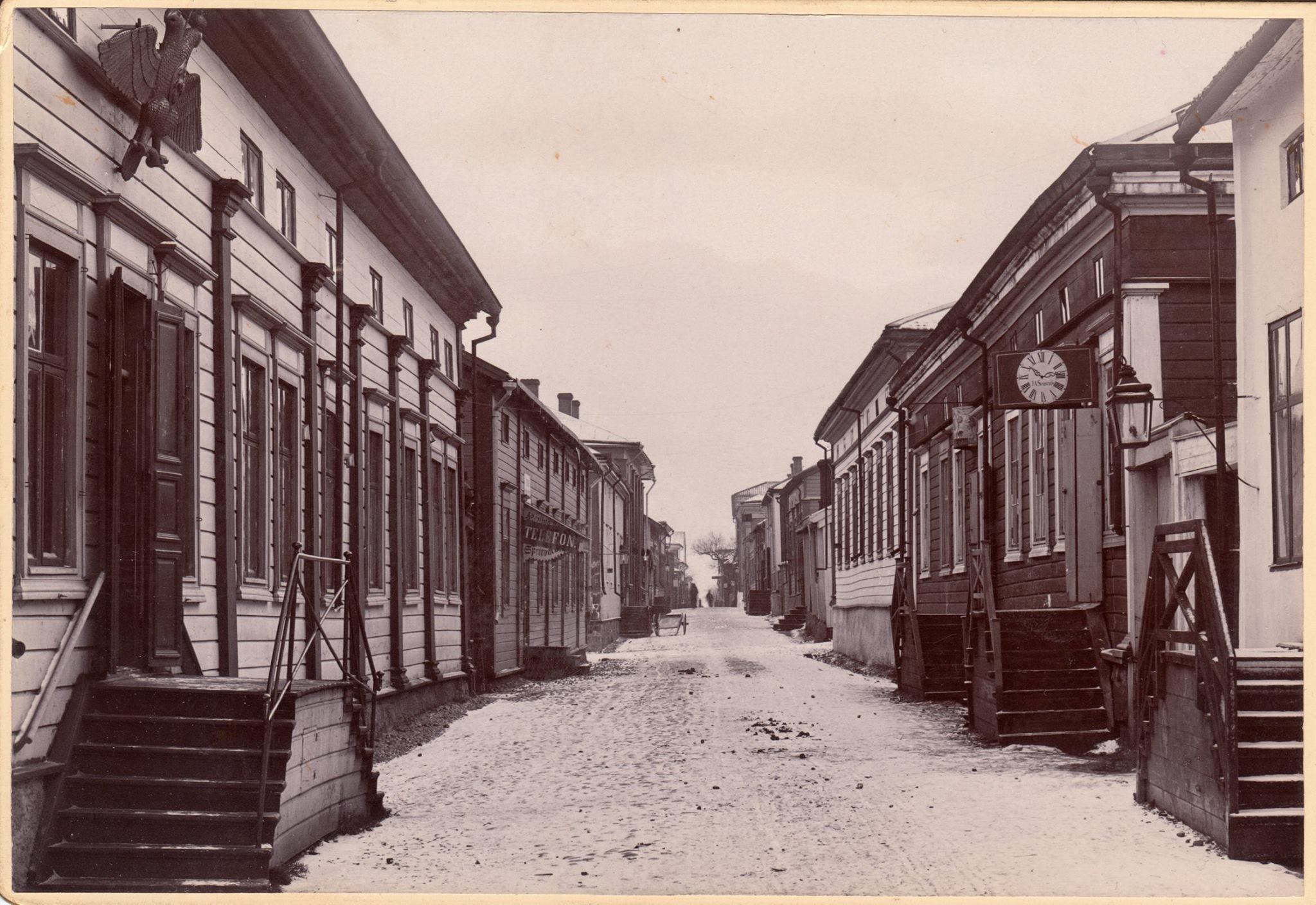
Delförstorning av titelbilden. Denna ryska kejserliga dubbelörn högg kosacker itu under revolutionen 1917 när de red förbi, enligt berättelse, berättad av nuvarande ägares farmor Margit, dotter till Henrik Sandlund
Ernst Sandlunds huvudvärkspulver, dock från tiden efter flytten av apoteket till torghörnet. Bild: Kerttu Laurila

Building history

The building history of the pharamcy house is described in the insurance letters from 1867 and 1902; the letter from 1867 is more detailed and essentially corresponds to the one from 1902.
Buildings 1-5 in the plan below were in 1867 as follows:

  1. Main building constructed of new timber in 1819, panelled and painted with yellow oil paint under a shingled roof (replaced with asphalt felt before 1902). The length towards the street is 28.50 metres, the width is 9.80 metres and the average height is 9.80 metres. In 1867 there was no glass veranda facing the courtyard, which means that it was built later in the 19th century and the entrance to the house was via the external staircase that is now located north of the veranda. There are 11 rooms with a total of 9 tiled stoves and a kitchen stove, while in 1902 the number was increased to 13 rooms (one of which was a pharmacy) with a total of 12 tiled stoves and a kitchen stove (in addition to an attic room with a tiled stove).
  2. At an angle to the main building and connected to it by a terrace-like staircase, a combined residential and storehouse building, built in 1819 for the residential part and 1822 for the storehouse, size 25.3 x 6.7 x 6.7 metres, boarded and painted with yellow oil paint under a shingled roof. There were 5 living rooms with a total of 3 tiled stoves and a kitchen stove, while the storehouse had three compartments.
  3. This house is partly built in 1828, partly in 1845, measuring 21.2 x 5.2 x 6.7 metres, boarded under a beaded roof and painted with yellow oil paint. The house comprised a combined farmhouse and bakehouse, a chamber and a laboratory (with a brick floor), the rooms containing a total of 2 tiled stoves, 1 large baking oven and a large stove in the laboratory.
  4. Finally, closest to the shore is an ice cellar built of timber in 1864 with double log walls and the space between filled with sawdust and coal dust. It measures 13 x 5.8 x 6.3 metres, is painted in yellow oil paint and has a beaded roof.
  5. Along the south side is a long outbuilding built in 1819, boarded and painted with yellow oil paint under a shingled roof. In 1867 the house was recorded as 37.3 metres in length, 5.5 metres in width and 5.2 metres in height and comprised a shack with a vestibule, a hay barn, a storehouse, a dunghill, a stable and a shed. By 1902 this outbuilding had grown to 64.3 metres in length and comprised an arched stone cellar, a wood shed, a stable, an outhouse with a dunghill, a shack with a vestibule and a feed barn, 3 store rooms, a wagon shed and a boathouse (the latter demolished in 1992-93).

The entrance gate was painted with light oil paint and the height of the garden fence was 1.5 metres and was painted with yellow paint. Towards the waterline there was a large landing bridge for boats.

Städernas allmänna brandstods-bolags försäkringsbrev N:o 6577
Planteckning af åbyggnadernas läge å Herr Apothekaren, Kollegii asessoren Fredrik Wilhelm Jurvelius egande gården N:o 170 i Fjerde kvarteret af Kristinestad samt dertill gränsande hus

Ritning till uthusbyggnad å tomten N:o 170 i 4de kvarteret av Kristinestads gamla plan
Harjoitustyö, Aalto yliopisto

Owners and residents

1836
Carl Gustaf Thodén
1837
Pharmacist, Collegii assessor Fredrik Wilhelm Jurvelius

1882
Pharmacist Karl Albert Dahlin
1890
Pharmacist Emil Reims

1895
Pharmacist Henrik Johannes Sandlund

1926
Ernst Sandlund

Page created by Dag Björklund

Uttergården

Uttergården

The current main building was built in 1897 by Captain Wilhelm Olin as the previous building had burned down, as had the main building on the neighbouring plot to the north. The house was moved here from the southern parts of town. It had survived the great fire of 1859 but had to be moved when the new church was built. The long outbuilding was built in 1838-39. At the time, the plot had a large pier with double stairs out into bay.

Building history

Plots 171 and 172 have been merged at least since 1864. The insurance policy dated 7 September 1864 mentions the original main building from 1838, which burned down in the 1880s and was replaced by the current main building from 1897. Of interest is that the original main building must have been a High Empire house painted with white oil paint and with a tiled roof, the proportions of the house were also of the Empire type, with external dimensions of 19.2 x 10.8 metres and a height of 9.5 metres and comprising 7 rooms and a kitchen. In 1864, all the outbuildings were also yellow, painted with yellow cooking paint, as was the fence, while the gate was painted with white oil paint.

The current main building was built by the merchant and sea captain Johan Wilhelm Olin, who insured the farm in 1898 (1908) and at that time there was a photography studio in the centre of plot 171. According to Lasse Backlund, the house was moved from Östra Långgatan, when the new church was to be built, 40 years after it survived the great fire of 1859 that ravaged the neighbourhood around the church. Read more about Salins gård, number 34A, in De gamla gårdarna, Ett försvunnet kvarter i stadens centrum, Nystén Lilly.

The house before it was moved from where the new church is now. Johan Petter Salin’s house Östralånggatan (nr 34A). At the gate: Aina Grönlund, Helga Snickars, Ida Rehnbäck, Dagny & Tilda Snickars, in the window Hanna Salin. De gamla gårdarna, Ett försvunnet kvarter i stadens centrum, by Nystén Lilly.

In the following insurance policy dated 15 January 1920, when the farm was owned by the merchant K.L. Saari, the plot had undergone a number of changes which resulted in the farm in its present form.

According to the latter insurance policy, the farm was built as follows:

  1. The main building on Strandgatan, built in 1897, boarded and painted with oil colour and with a tin roof. Size 22.50 x 10.50, with an average height of 9.50 metres. The house includes 11 rooms with a total of 8 tiled stoves and two kitchen stoves as well as two verandas measuring 3×3 metres and 3.5 metres in height.
  2. At an angle to the main building on the north side of the plot, a residential building built in 1838 and 1939 and rebuilt in 1919, boarded but still unpainted, measuring 10 x 5.34 metres and 5.64 metres high. In its original form, the house included a baker’s hut and a fruit room with a baking oven and a tiled stove, but after the reconstruction it became 4 rooms with a total of two tiled stoves and a kitchen stove and a veranda 3 x 2.8, with a height of 3 metres.
  3. Economy building built in 1838 and 1839, boarded and red painted with asphalt felt roof. Measuring 35 x 5.34 metres and with a height of 5.64 metres, it comprises two two-storey warehouses, two firewood sheds, stables, cattle shed, feed barn, outhouse and dunghill.
  4. At the far eastern end of the site a residential building built in 1919 with a beaded roof, still unpainted. Measuring 8.6 x 6.6 metres with a height of 6.8 metres and comprising 2 living rooms with 1 kitchen stove with baking oven and walled-in pot and a sheet metal stove.

There were also two buildings in the centre of the plot which are now gone – an 1892 tool shed (the former photographer’s studio) made of timber and boards and an earth cellar with a turf roof.
The entrance gate and plank (18 metres long and 2 metres high) were painted with oil paint.

Byggnaderna 1-4 som behandlas i brandförsäkringsbrevet, samt grannarnas närliggande byggnader. Ur brandförsäkringsbrevet 1840
Allmänna brandstodsbolaget i Finlands försäkrinsbrev No 1844 för gården No 171 och 172 från år 1840.
Försäkringsbrev N:o 5670 för gård 172, Städernas allmänna brandstods-bolag i Finland, tecknad år 1864.
Försäkringsbrev N:o 20078 för gård 171 och 172, Städernas allmänna brandstods-bolag i Finland, tecknad år 1898.
Planteckning af åbyggnadernas läge å Rådmannens G.E. Strandmans egande gård N:o 172 i Tredje qvarteret af Kristinestad, samt dertill gränsande hus. Ur brandförsäkringen 1864. Här syns ursprungliga huvudbyggnaden som brann, samt bryggan ut i fjärden

Planteckning af åbyggnadernas läge å Sjökapten Johan Wilhelm Olins egande gårde N:o 171 & 172 i trejde kvarteret af Kristinestad jemt dertill gränsande hus. Ur försäkringsbrevet 1898. Här finns den nuvarande huvudbyggnaden med.

Owners and residents

1864
Rådmannen G.E.Strandman

1908
Sjökaptenen Johan Wihelm Olin

1916

1920
Handlanden K.L.Saari

Strandgatan 4

Brandförsäkringsbrev N:o 2794 från år 1849 å gården No 89 i andra qvarteret af Staden Christinestad, tillhörig Handladen C.M.Riddenstad
Brandförsäkringsbrev N:o 28851 från år 1909 å gården 89 i andra qvarteret af staden Christinestad
Brandförsäkringsbrev N:o 36695 från år 1918 å gården 89 i andra qvarteret af staden Christinestad
Brandförsäkringsbrev N:o 39062 från år 1919 å gården 89 i tredje qvarteret af staden Christinestad
Ritning öfver en förändring af fasaden emot Strandgatan på byggnaden norr om portgången å gården No 89 i denna Stads andra qvarter till hörig enkefru Mathilda Sundström.
Lit A, Facaden seendes från Strandgatan som den nu befinnes.
Lit B, Att i norra fönstret att få upplaga en dör och
Lit C, Trappans brädd och lengd seendes uppifrån brolocket.
Kristinestad, den 1, December 1877. af Gustaf .Fr Hartman
713_KVARTER_2_TOMT_97_AR_1834-1

Strandgatan 42

Ritning till fasadförändring af Karaktärsbygnaden å tomten no 90 i andra Kvarteret af Kristinestad

Strandgatan 42

Ritning till fasadförändring af Karaktärsbygnaden å tomten no 90 i andra Kvarteret af Kristinestad

Strandgatan 42

Ritning till fasadförändring å gården No 42 vid Strandgatan, Tomten No 90 i andra kvarter av Krisinestads gamla plan